Standardisation, Cost & Control in the Global Tea Trade
Blending occupies a central yet often misunderstood position within the global tea industry. While frequently perceived as a compromise on purity or origin, blending is more accurately understood as a structural response to variability, scale and market dynamics.
Tea, as an agricultural product, is inherently inconsistent. Variations in soil composition, altitude, rainfall, crop yield, pest management and seasonal timing produce potentially measurable differences in flavour, colour and aroma, even within the same estate and harvest cycle. For early global markets, particularly in 19th-century Britain, where tea consumption expanded rapidly, this variability posed a fundamental challenge. Consumers increasingly expected continuity in taste, while production remained subject to environmental & therefore, agricultural fluctuation.
Blending emerged as a mechanism to reconcile this mismatch.
Historical accounts of the tea trade indicate that by the late 19th century, merchants operating through auction systems in London and Calcutta routinely sourced teas from multiple regions to construct stable flavour profiles. As documented in studies of imperial trade, including those referenced by the Food and Agriculture Organisation, the shift from single-origin consumption to blended products coincided with the industrialisation of tea and the distribution and expansion of mass markets. Blending, in this context, was not incidental but necessary to standardisation & sensory consistency.
The primary function of blending, therefore, is not dilution but standardisation and control.
At a technical level, blending allowed producers and brands to stabilise key sensory attributes like liquor strength, colour, aroma and mouthfeel across batches. This is achieved through the calibrated combination of teas with complementary characteristics. For instance, stronger, high-body teas from Assam may be combined with lighter, more aromatic teas from Nilgiri to achieve both depth and complexity within a single blend.
The evolution of the English Breakfast tea illustrates this particularly well. Historically, the blend drew from three principal imperial origins of Assam, Ceylon, and East African teas, particularly Kenya, with the British market itself effectively defining and standardising these origins within the global trade. Over time, however, changing market preferences, supply economics and price positioning gradually shifted the composition toward a predominantly Assam-based blend for the United Kingdom market. While the name remained unchanged, the formulation evolved significantly, demonstrating how blends are not static recipes but adaptive commercial constructs shaped by availability and consumer expectation.
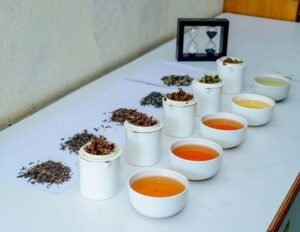
Such formulations are not arbitrary. They are developed through systematic tasting processes, often conducted in controlled environments where trained tasters evaluate large volumes of samples daily. Sensory assessment follows established parameters, and successful blends are codified into reference profiles that must be reproduced consistently over time. The role of the blender, therefore, is not merely additive but analytical, requiring both sensory acuity and memory.
From an economic perspective, blending also enables cost optimisation. By incorporating teas of varying grades and price points, producers can maintain a consistent retail product while managing fluctuations in supply and input costs. Higher-grade teas may be used selectively to enhance flavour or aroma, while more readily available varieties provide volume and structural balance. This does not necessarily imply a reduction in quality; rather, it reflects a redistribution of value within the blend.
At the same time, the increasing importance of price-point competition within large retail markets has contributed to the commoditisation of the tea itself. As supermarkets and mass-market brands prioritised affordability and uniformity, blending systems became increasingly oriented toward achieving acceptable consistency at scale rather than preserving distinctiveness of origin. The result has been the emergence of an “average” market profile: teas engineered for predictability, accessibility and cost efficiency, often at the expense of complexity or terrior expression.
From a quality and compliance perspective, blending also serves an important regulatory function. Since teas from certain origins may naturally exhibit lower pesticide residues or cleaner compliance histories, strategic blending allows producers to align finished products with the food safety standards of specific export markets. In this sense, blending operates not only as a sensory and economic tool, but also as a mechanism of regulatory risk management within global trade systems.
The global scale of this practice is significant. Industry estimates suggest that a substantial majority of commercially available teas are blended prior to retail, underscoring the extent to which blending underpins the modern tea economy. It facilitates not only consistency but also scalability, allowing brands to operate across geographies without being constrained by the limitations of individual estates or harvests.
However, the standardisation enabled by blending introduces a secondary dynamic.
As flavour profiles become fixed, often in response to consumer expectation, there is a tendency toward homogenisation. Blends that achieve commercial success are required to remain stable, even as the underlying agricultural inputs continue to vary. This places increasing pressure on blending systems to absorb environmental and market volatility without altering the end experience.
In this sense, blending functions as a mediating layer between production and consumption.
Yet, parallel to this industrial model, a counter-current has also emerged. As consumers increasingly seek provenance, traceability and narrative in food and beverage consumption, demand for single-origin and estate-specific teas has grown steadily across premium segments of the market. Retailers and specialty brands have responded by allocating greater shelf space to teas positioned around terrior, harvest season, maker identity and regional storytelling. In contrast to standardised blends, these teas derive value precisely from their variability and distinctiveness, reframing inconsistency not as a flaw but as an indicator of authenticity.
In this sense, the contemporary tea market now operates through two parallel value systems: one prioritising consistency, scalability and price efficiency through blending; the other emphasising origin, scarcity and sensory individuality.
Blending, therefore, functions as both a technical and strategic mechanism. It translates agricultural variability into commercial predictability while aligning sensory outcomes with market positioning.Situated at the intersection of agriculture, sensory science and commerce, the process is an act of design.
To characterise blending as dilution is to overlook this complexity.
The objective is not to erase difference, but to organise it into something repeatable, recognisable and scalable. The resulting product may draw from multiple origins. Its identity, however, is constructed.