Why one of the world’s most distinctive infusions still calls one mountain range home
The trouble with maps is that they make everything look negotiable. Draw a border around something, give it a name, and it begins to seem transferable. Coffee came from Ethiopia; now it grows in Vietnam. Tea travelled from China to Assam, then to Kenya, then almost everywhere altitude and empire happened to intersect. Grapes have spent centuries ignoring national boundaries with admirable confidence.
Rooibos, by contrast, has remained stubborn. It grows naturally in one small corner of South Africa’s Cederberg mountains and has shown remarkably little interest in becoming cosmopolitan. Horticulturists have tried. Markets have certainly tried. Consumers, accustomed to the reassuring fiction that anything can be grown anywhere provided someone invests enough money, continue to be mildly surprised by the news. Nature, naturally, remains unconvinced.
There is a tendency, particularly in food writing, to mistake locality for romance. We speak reverently of “sense of place”, “terroir”, and “heritage”, usually while standing safely within driving distance of a specialty grocery store. But rooibos presents a rather less sentimental case. It is not local because exclusivity photographs well. It is local because evolution, over several million years, arrived at an arrangement that is irritatingly difficult to improve upon.
The Cederberg mountains in South Africa
The Cederberg is hardly an obvious advertisement for agricultural abundance. Its soils are sandy and poor. Rain arrives according to a Mediterranean rhythm that would puzzle most tropical crops. Summers are dry enough to discourage optimism. Yet this is precisely where Aspalathus linearis—the rather unassuming shrub that becomes rooibos—tucked itself in for the long haul, and adapted.
This leads us to a rather odd, but sincere, analogy. Plants, like academics, have an unfortunate habit of becoming highly specialised to the extent of being labelled niche.
Which brings us to one of the stranger habits of modern consumption. We have become accustomed to believing that successful crops should scale indefinitely. If avocados can appear in January and blueberries can cross continents before breakfast, surely rooibos ought to follow suit, and the very fact that it doesn’t takes on an almost impolite snub. All, however, bow down to this one universal truth hardly acknowledged: biology cares but scarcely at all for convenience.
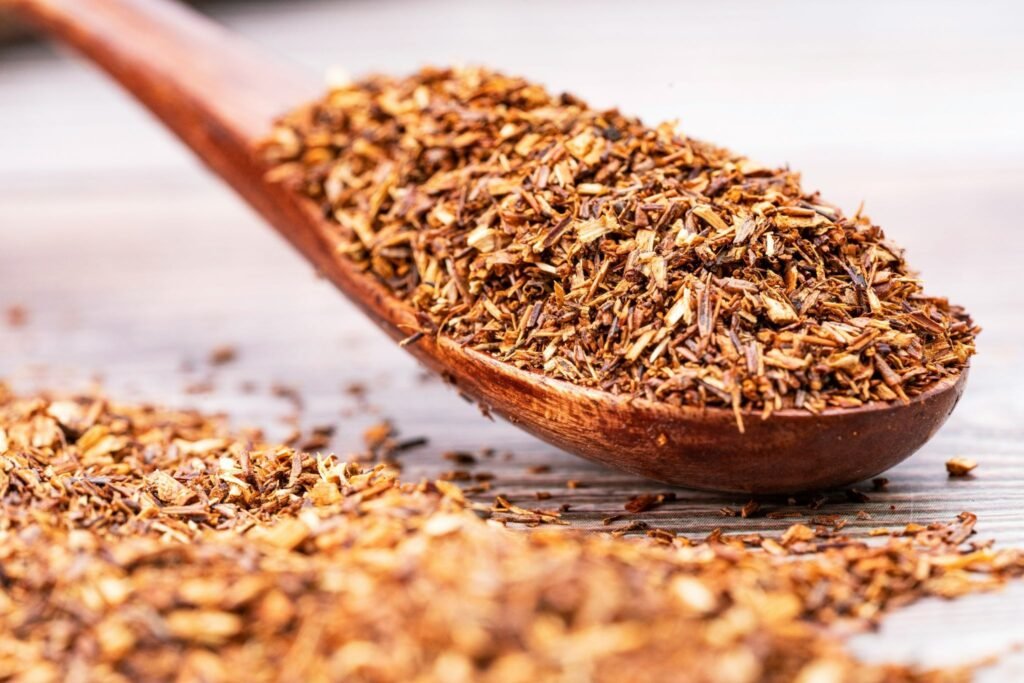
Rooibos gets its signature redness from oxidation
Rooibos belongs to the fynbos, one of the most botanically diverse ecosystems on the planet. Thousands of species occupy this comparatively small stretch of landscape, many found nowhere else. It is an ecosystem built on fire, drought, nutrient-poor soils, and an evolutionary arms race that has been running for considerably longer than humans have been assigning tasting notes to beverages.
This is perhaps the most useful corrective rooibos offers. We spend a great deal of time asking what a drink tastes like and rather less asking why it exists where it does. Geography is often treated as background scenery when, in reality, it is one of the principal authors.