Allow me the occasional alliteration that makes you wince, but this headline seemed to have written itself. By now, we’ve laid bare the fact that tea goes beyond its status as a caffeinated beverage occupying pride of place in households, offices, restaurants, and commercial spaces alike, transcending geography and climate. Let’s zoom in, however, to the role this drink occupies in our vastly varied but commonly united subcontinent.
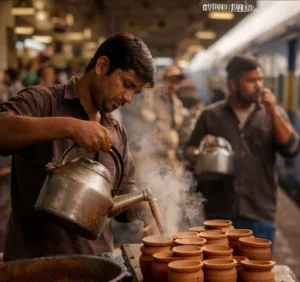
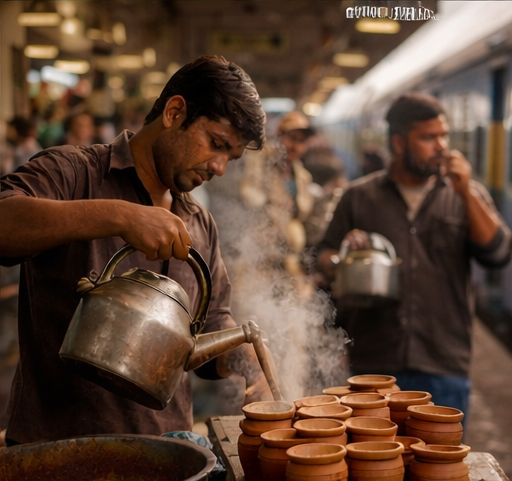
Step onto any Indian train station at daybreak, and you’ll be greeted with a familiar entourage of senses being invoked. Steam rising from clay cups, tea being poured, nasal calls that interrupt your travel-focused mind and invite you to slip away, the clatter of steel against steel as your tiny, hot cup of tea is prepared. You sip. You savour. And you board this train that will take you through the country’s history, culture, and daily tea rituals.
Our journey starts in the northeast, where clouds of mist cling to the rolling hills, and tea bushes stretch as far as the eye can see. Assam, the land of the boldest black teas, produces millions of kilograms annually. At nearly 700 million kg alone, Assam contributes to nearly half of India’s total production of tea.
Here, workers pluck the tender two leaves and a bud by hand, an age-old tradition passed through generations. These leaves will undergo the CTC (Crush–Tear–Curl) process, creating the brisk tea that forms the backbone of India’s daily chai. The aroma of Assam tea is carried not just to homes but eventually to train stations, offices, and cafes across the country.
As the train snakes westward into West Bengal, the scenery changes. Hills once rolling and stepped now change their appearance to rise sharply, and the air smells of floral, musky Darjeeling leaves — India’s first speciality tea, exported globally since 1853. Darjeeling teas, mostly orthodox in processing, are delicate and fragrant, a contrast to the robust Assam brew. India ships over 250 million kg of tea annually worldwide, with Darjeeling commanding high demand among international tea connoisseurs.
Our mythical train now chugs along and slows at the bustling platforms of Kolkata, Mumbai, and Delhi. Clay cups clink, mimicking the unquenching footfall. Steam rises yet again, and vendors move with practised rhythm. Once again, you’re reminded of the millions of cups that fuel the commute of the frequenters of India’s railway network.
Tea’s journey often finds itself deeply entwined with the rigmarole of daily life. Roughly 84–90% of India’s tea production stays domestic, brewed in homes, offices, and stalls, connecting strangers, colleagues, and friends with a shared passion for this simple yet transcendental beverage.
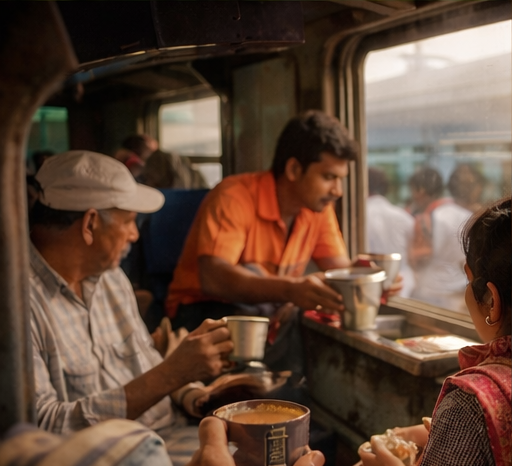
The train now ascends to the high-rises of Bengaluru and Mumbai. Glass towers catch the morning light as hands reach instinctively for the first cup of the day. On terraces overlooking a restless skyline, employees stir milk into their cups, overlooking the cityscape, while in offices, tea breaks punctuate busy workdays. In India, tea consumption averages 840 grams per capita annually, and it is this daily ritual, from train stations to terraces, that takes the form of an unbroken thread linking production, trade, and lifestyle.
This journey carries on, moving past warehouses and winding tracks that lead to ports where this familiar brew prepares to travel far beyond its origins. Packed into chests and containers, it leaves behind the hills and plains, destined for foreign shores. Yet, even as it journeys outward and beyond, its strongest roots remain here in kitchens, at roadside stalls, and in office corridors, where the ritual continues, cup after cup, sip after sip.
Look closely, and you begin to see how it all conspires to connect. The leaves that were plucked in a hush of mist now arrive, quite unceremoniously, into the everyday theatre of living. Into clay cups that warm impatient hands on crowded platforms, into steel tumblers that ring lightly in small kitchens where mornings begin before the sun has quite decided to show up, into porcelain cups perched on tables that have seen more conversations than conclusions. The settings shift, the vessels change their manners, but the comfort remains stubbornly the same, familiar in a way that refuses to be explained.
And before you can properly account for it, the train has already circled back. It always does. It leaves you exactly where you began, except now you are holding the story in your hands. Your cup, your corner, your brief and borrowed pause. What travelled across hills and histories now settles quietly between your palms, carrying with it fragments of labour, trade, time, and all the small, unnamed things in between. Tea in India often finds itself on this train that arrives but never really departs. It lingers, it loops, it returns to itself, threading through lives and landscapes with a kind of patient insistence, until you realise it was never really going anywhere at all.